Sunday, April 11, 2021

On the Christianity of White People

It’s fashionable nowadays — at least in some circles in the media and social media — to talk about America’s “racial reckoning,” triggered by the death in police custody of George Floyd. Maybe there is and maybe there isn’t a “racial reckoning” happening in America. I know a lot of black people are saying this “feels” different. Most white people don’t really even understand what that means. This feels “different” than what?

In my history classes, I taught my students that America has actually had at least three prior “racial reckonings.” It’s happened before. And before, it’s never ended up really fixing the fundamental problem of American racism. The three prior “racial reckonings” were: 1) the American Revolution, 2) the Civil War and Reconstruction period, and 3) the Civil Rights Movement. These were all moments in history when significant numbers of white people “woke up” to the significance of racism: not just what it meant for black people, but what it meant for our democracy and what it meant for our basic humanity as a people. Significant numbers of us, if not all of us, recognized the stakes. But in every prior moment of “racial reckoning,” we white folks failed to act in such a way as to bring about a permanent reversal of racist injustice and inequality. The history of America is largely a history of white people periodically waking up to racism, only to fall asleep again a few years later. Maybe we will make good this time. Anyone really calculating the odds with a knowledge of our history wouldn’t bet on it. But, the remarkable thing about human history is it all boils down to agency. We can choose to make good on the promise of America if we decide to get serious about it.

When I taught American history, it was from the perspective of American religious experience. And as a student of American history I can say that before racism was a political or social crisis in America, it was a profoundly spiritual crisis. That is so because European Americans by their own admission knew that slavery was contrary to their Christianity, and in order to make room for slavery, they had to apostatize. That’s a fancy word that means they had to abandon their faith. Out of that abandonment of our faith, “whiteness” was born, and “racism” became the way of preserving and defending whiteness.

There are many examples we can draw on from American history to show that European American Christians apostatized by choosing slavery and racism over basic tenets of the Gospel. One of the earliest examples came from early in the history of American slavery, in the form of a debate over whether African slaves could or should be baptized. Early American Christians believed that their faith made it unlawful for a Christian to hold another Christian in bondage. In other words, baptizing the slaves would make them unfit for slavery. On the one hand, the Gospel taught Christians to “make disciples of all nations,” to “preach the gospel and baptize all nations in the name of the Father, and of the Son and of the Holy Ghost.” In other words, our faith demanded that the slaves be baptized. On the other hand, there was the economic loss of giving up slaves once they converted. In the face of this moral dilemma, slave owners refused to allow their slaves to hear the Gospel preached, and they refused to let them be baptized. Some Christian preachers, thinking there was some inherent benefit in baptismal water that somehow justified the demerit and dehumanization of slavery proposed a compromise: pass a law that prohibits a person from being emancipated just by virtue of being a Christian. Virginia was the first British American colony to pass such a law in 1667, and these laws quickly spread to other states throughout the American South. Thus began the first in a long series of compromises with their faith that white Christians made in order to rationalize their inhumanity. “Compromise” is a nice euphemism for “apostasy.”

My own people, the Latter-day Saints, have a history of such compromises as well. Most early Latter-day Saints hated slavery and saw it as fundamentally incompatible with the Gospel. Joseph Smith bucked contemporary trends that tended to force African Americans into separate, segregated Christian communities, by ordaining black men like Elijah Abel and Walker Lewis to the priesthood, and by integrating African Saints into the Church along with everyone else. When the Saints began to settle in Missouri, a strongly pro-slavery state, their abolitionist views got them in trouble with the local populace. It was one of the primary reasons Missourians began to fear the growth of the “Mormon” population in the state, and one reason why Latter-day Saints were persecuted and lynched and ultimately driven out of the state under threat of an extermination order in 1839. But after the prophet Joseph Smith was himself lynched at the hands of an angry mob in 1843, the leadership of the Church passed to Brigham Young. Brother Brigham was less comfortable with a racially integrated Church. In 1849, then President Young banned individuals of African descent from holding the priesthood or receiving temple endowments or sealings. He flirted with the idea of joining the Confederacy during the Civil War. Latter-day Saints began to preach against the evils of miscegenation. Utah began to practice both legal and extra-legal forms of segregation. And Latter-day Saints began to promulgate theologies that justified unequal treatment, such as the notorious teaching that the spirits of unfaithful children of God were sent to be born into families with African ancestry. This was a theology that Pres. Dallin H. Oaks officially declared to be false (i.e., apostate) in this talk at the 40th anniversary celebration of the 1978 revelation ending exclusion of individuals of African descent from the priesthood and temple.

All of us hold beliefs that are contrary to the Gospel. It’s part of the human condition, I think, to live only partly in the light. It is the nature of the Restoration of the Gospel to, line upon line, precept upon precept, dispel the darkness and to walk more and more in the light. The process of freeing ourselves from falsehood and living in harmony with the truth is by its very nature an arduous process filled with missteps. Sometimes rationalization of sin wins out over recognition of the truth and repentance. God still loves us. The gospel teaches that God loved us while we were yet sinners. But it doesn’t change the fact of our being sinners. It doesn’t negate the necessity of making inconvenient choices as part of the process of redeeming ourselves.

But there is another basic Gospel principle that I have learned myself the hard way. It is that sinning against the light plunges us into darkness much more quickly and more dangerously than sinning in ignorance. When we engage in a process of preferring our rationalizations to the light, we soon become incapable of hearing the Spirit. We can only fail a test so many times before our spiritual bondage becomes irreversible. The cries of our African-American brothers and sisters are ascending to the throne of God. The blood of the martyrs is crying up to God as well. If we want to be aligned with God, we need to hear those cries too. We need to act. We need to bring about real change. Our salvation literally hangs in the balance, not just spiritual salvation but physical and political and social salvation too. To paraphrase Abraham Lincoln, our democracy can’t survive if we let racism thrive.

There are at least three prior moments in our history as a nation when this test was placed before us in a way that we saw it and understood it clearly. And we collectively failed the test at least three times. One of the lies that has time and time again perpetuated apostasy in relation to this issue has been that a one-time fix would somehow be good enough. From the vantage point of his second inaugural address, Lincoln saw clearly that God‘s judgment had been upon us. Lincoln believed that God might, by the sword, extract of white Americans every drop of blood drawn from their slaves with the slave master’s lash. Americans acted by enacting the 13th, 14th and 15th amendments to the constitution of the United States, formally ending slavery, giving black Americans the right to vote, and denying states the ability to abrogate those rights. But once that had been done, white Americans satisfied ourselves that our work was done, and we allowed states to pass “Jim Crow” laws stopped black Americans from voting, even as they still had the formal right. We allowed economic inequality to lapse into slavery without formality, but in substance. We largely acquiesced in the lie that simply declaring the slaves free was enough even if they didn’t have an economic foundation for real freedom. We engineered a society where white folks mostly don’t have to interact with black folks if we don’t want to, though few black folks have the same privilege. That social separation, that social distancing, has made and continues to make it easier for us to blind ourselves to the very real human misery that continues to exist under racist social norms and structures, the unexorcized ghosts of American slavery.

One aspect of apostasy is eyes that are unable to see, ears that are unable to hear, hearts that are hardened and impenetrable. When we are starting to feel defensive, starting to feel attacked In these kinds of conversations, it’s a sign of hardened hearts. There’s freedom for us in letting go of our defensiveness and listening and letting what we hear sink in. There is hope in opening our eyes and seeing, the way we saw when that terrifying video of George Floyd’s murder was posted all over the Internet.

God is merciful. He’s giving us as a nation a fourth moment. He’s giving us a choice again. We need to ask ourselves a very serious question. And the question is, “what do we need to do differently this time to make sure that reform doesn’t turn into backsliding? What are the specific covenants we must make to ensure that as a nation we cease to be black and white, bond and free, male and female, in which we can become of one heart and one mind and dwell together in righteousness?” As in every similar juncture in our history there are critical choices before us related to practical issues such as: How do we ensure that our justice system is just for everyone? How do we ensure access of all to our political process? How do we ensure that economic inequality doesn’t undermine social and political equality? How do we deal with organized terror perpetrated by white supremacist organizations and philosophies? These questions have been with us for over 200 years and they will continue to be with us until we get them right.

I don’t know if we will get them right but what I do know is that it is within our power. Our agency, God‘s greatest gift to us, is all that we need to fix this, just as it is all that we need to fix anything in our lives. We exercise agency. God bestows grace. God’s grace opens greater possibilities for agency. We use greater agency for right and God bestows grace upon grace. That possibility fills me with hope.

I pray for that light filled, hope filled future, in the name of Jesus Christ. Amen.

And then we get up off our knees and work for God‘s will to be done on earth as it is in heaven.

Monday, July 15, 2019

Heat Resistant Love Needed

I have a confession to make.

I am not angry at the Church.

I know that makes me a bad or brainwashed queer in the minds of many. Over the years I’ve had to become accustomed to being dismissed as a toady or as a Stockholm Syndrome victim.

I understand the anger, much, much better than most people seem to think. My self-awareness and coming out process started in the late 1970s and early 1980s. I arrived at BYU only a couple of years after electroshock aversion therapies stopped on campus. I remember walking past a building on campus that my friend Roger Leishman pointed to and said, “That’s where it happened.”

I knew a guy who voluntarily strapped electrodes onto his body over 40 times, and who had burn scars on his arms from trying to stop being gay. I had a friend who made repeated suicide attempts after his conversion therapy failed. I never went through that, but in 1986 I survived a summer where the only reason I’m still here is because the opportunity to carry out my plan never presented itself. It was only lack of opportunity that saved me.

After I survived, I crashed and burned out of BYU, and tried quitting the Church (and was excommunicated instead). And as I started to figure out how and why the things in my life happened the way they happened, I became angry. Very, very angry.

Other things made me angry too in the late 1980s and early 1990s. I watched good friends die of AIDS and saw friends totally abandoned by their families and treated like garbage. A friend nursed his partner through a painful death of complications caused by AIDS, and then was kicked out of their apartment by his partner’s family and banished from the funeral. Good Christian folks. His story wasn’t uncommon. Back in those days, you just assumed that if you were queer, you were on your own to create a chosen family, because your biological family wouldn’t have your back.

I understand anger. It’s been a travel companion of mine for many years. Until it wasn’t any more. Until I took a fork in the road that anger couldn’t follow any more.

One of the things I gradually realized is that every single one of the beliefs at the root of rejecting behaviors “out there” that hurt me so bad were beliefs that I had once fervently held. In my senior health class I defended gay bashing on the grounds that it “might help them to change.” It took many years of searching and personal growth for those scales to fall from my eyes (and from my heart). And I’m gay!

It took time for *me* to have compassion on the fourteen-year-old me who read The Miracle of Forgiveness and who was scared to death that he might be forever lost to the power of Satan and that it was *all his fault.* If I could forgive myself for taking eleven long years to learn to love and accept that fourteen-year-old self enough to come out of the closet and start telling his (and my) story, I could also find it in my heart to forgive the parents and teachers and bishops who fiercely loved me (and him), but just didn’t understand any better than I had understood myself back then. I forgave them because I knew that they knew not what they did, and I knew first-hand the complexities of doing one’s due diligence to figure this stuff out.

Anger was a natural reaction, no different really from cursing the skies when I accidentally miss the nail and bang my thumb with a hammer. (I did that a few times as a teenager doing summer work to earn money for my mission.) But anger didn’t ultimately serve that fourteen-year-old me, and it didn’t ultimately serve the people who mattered most in my life.

Forgiveness did serve, both me and others. Forgiveness unlocked the floodgates of healing tears, of self-acceptance and other-acceptance, of love and hope and faith.

I say this knowing very well that forgiveness can’t be forced. It can’t be demanded. And anger tends to have to run its course. As I said, we tend to walk with anger, until we don’t any more. Until the fork in the road that anger can’t follow looks brighter and better to us.

So I plead with my fellow Latter-day Saints, have patience with our white-hot anger. One of the best ways for it to run its course is for it to be heard out. Your love for us has to be heat resistant if you want to walk with us. If you want to minister, if you want to help, you need to hear us and walk with us even in our anger.

The fork in the road for me was the recognition of how fully and truly and deeply God knew me and how much he loved me. God had spoken to me numerous times over the years, but it took me a while — several years — to actually hear what God was saying to me and to fully believe it.

God told me that he knew me “from my inmost being,” the part of me that was eternal, and he told me it was in that part of me that I was gay. And he told me that he loved me exactly the way I was with a depth and a passion that I could barely understand. The only way I could even begin to apprehend the depth of that love for me is the realization that God was willing to suffer in the garden, to be taken and flogged and spit upon, to bleed at every pore and to be nailed to a cross for me. To experience the full agony of a violent physical death, for me. I know now that the atonement only scratched the surface of his love for me.

His suffering and death, and his rising resplendent from the tomb, and his revelation of himself, his beauty, his light, and his healing, to me personally, to us, to the church today and in every age, are reason enough to me to forgive and to hope. And to let go of every last ounce of anger.

When we are rejected by others, the reason it hurts us so bad is because that rejection adds fuel to the flames of our own shame and self-rejection.

Once we fully accept and love ourselves, once we see ourselves as the beings of light and love that we are, which is exactly how God sees us, there is no arrow or dagger or stone flung at us that can hit us. We’ll be like Samuel up on the walls of Zarahemla.

I have been hurt by some of you. By some of us. I’ve been knocked upside the head by some of the angry bricks you’ve flung. It hurt partly because I took for granted your love and acceptance and understanding, and was shocked by your display of the lack of it. It also hurt because my only desire ever has been to heal and to help, and people were telling me that *who and what I am* was harming people. It caused me to doubt. It hurt.

I’ve watched us doing this not just to me but to many others on both sides of the no-man’s land between so many members of the church and so many members of the LGBTQ community. The collateral damage, the “friendly fire” needs to stop. It won’t help us “win.”

It’s taken me a bit of adjustment, of prayer and fasting and searching, to forgive that too.

I recognize that like the pain I experienced years ago as a young teacher, priest and elder that almost caused me to end my life, the in-fighting in the LGBTQ Mormon community is a reflection of the larger brokenness. It’s part of the bigger problem that we all need to stay focused on healing, and that will take time and patience and inter-connection with each other in order to heal.

I believe in that work of healing and am more committed to it than ever.

In Jesus’ name, Amen.

Tuesday, October 23, 2018

With a Sincere Heart, with Real Intent

In the early 1990s I was involved in an increasingly heated discussion within the Evangelical Lutheran Church in America about homosexuality. I participated in a couple of dialog events where information and perspectives on homosexuality were presented that were participated in by liberals and conservatives -- across the theological spectrum within Lutheranism.

At one point I remember having a conversation with a conservative evangelical Lutheran pastor. What he told me, I felt, was very revealing. He believed that the "biblical" position on homosexuality was that it was a sin. If that position were shown to be wrong, then he would lose faith in his ability to get any truth from the Bible. He said, "If we can't count on the Bible, what do we have left?"

My gut reaction came from the spiritual wellsprings of my upbringing as a member of the Church of Jesus Christ of Latter-day Saints. I said to him, "We have God, of course!" I thought, "Where do you think the Bible came from?"

Thanks to my Mormonism, my faith as a Christian didn't depend on a view of scripture as 100% inerrant. I believed in a God who could reveal (and had revealed) himself to me personally, and who could give (and had given) me direct answers to the most perplexing questions in my life, even (or especially) when the words in a book didn't seem to do that very well. As Joseph Smith put it, "for the teachers of religion... understood the same passages of scripture so differently as to destroy all confidence in settling the question by an appeal to the Bible."

Of course I've run into the same problem among Mormons. A lot of Mormons want to do the same thing for "living prophets" that a lot of Protestants have done for the Bible. "Living prophets" are not "inerrant" for the same reasons that the Bible is not inerrant. This gets us to the root or the heart of the problem -- whether you are a Mormon or a conservative Evangelical.

If what you want is some "never wrong" external source of authority, you will be disappointed (traumatically disappointed even!) time and time and time again. The search for Truth with a capital T requires more personal engagement than just believing that some interpretation of scripture or some doctrinal pronouncement is infallible. It requires us to engage in a personal quest that requires risk.

"What if I'm wrong?" is one of the most painful questions to emerge from this messy human experience we are all having. And lots of us try to avoid that question by believing (wishing?) that some external authority can take away from us all risk of being wrong. If THEY'RE right 100% of the time, then I can always be right by just following them 100%.

I actually have become profoundly convinced that that's not God's plan for us (another insight that comes from deep within the spiritual wellsprings of my faith as a member of the Church of Jesus Christ of Latter-day Saints). I absolutely believe that God intended for this experience to be challenging and messy and to demand of us the utmost personal risk in learning how to become like Him.

In other words, there's no way for us to avoid being wrong once in a while.

*****

From this I also learned something important about the painful conflicts many of us are experiencing around LGBTQ experience and the church.

It was painful for me to feel that my experience as a gay man was invalidated or not believed by other Christians. But when I had this conversation with this conservative evangelical pastor, I realized that for him this was not about me personally at all. It wasn't about LGBTQ people in general at all. It was about him trying to hold on to a particular type of moral and spiritual compass. It was about this big question of how do we know truth and how do we make our way through the world.

In other words, it was not that he was a bad person. Quite the opposite. He was a very, very good, admirable person, wrestling with big questions about truth and how to find it and how to live by it. And for that, I was able to forgive him for not "getting" it, for not seeing things exactly the way I see them, as I hope others will forgive me for not seeing things their way, and even for being wrong on important matters that affect them.

What I believe is that we all have a better chance of getting to that place of perfection and truth we're all striving for if we have patience, if we go about it with a lot of love and forgiveness, and if we seek truth "having faith" that we can find it, "with a sincere heart, with real intent," and with more humility than we've had in the past.

Tuesday, March 6, 2018

1 Corinthians on Sex and Marriage

1 Corinthians 6 contains one of the texts typically used by Evangelical Christians (and some Mormons) to condemn homosexuality.

A lot of energy in the debates over this scripture focuses on the proper translation of a couple of terms in verse 9 that have been translated in the King James Version as "effeminate" and "abusers of themselves with mankind." A footnote in the LDS edition claim that the word translated as "effeminate" here means "catamite" in the original Greek. (I don't think that's true... I think the Greek word here is "malakoi," which means "soft". Who knows whether Paul was referring to "catamites" or "boy escorts" that were common in the ancient Greek and Roman worlds.) Another footnote links "abusers of themselves with mankind" with "homosexuality." In some versions, this gets translated as "homosexuality," in others not.

But, read in context here, I think the translation really doesn't matter. How we render some of those terms into English is moot, since Paul follows this list of sins with this declaration: "All things are lawful unto me."

What does this mean? It means that the Gospel of Jesus Christ does not consist of a list of do's and don't's.

Look at the context of what Paul says here, from verse 9 through the end of the chapter in verse 20. He's talking about "fornication," about "harlots." He's talking about a way of life in which we allow ourselves to be governed by worldly appetites rather than by the Spirit. If Paul is talking about homosexual behavior here, it's clearly homosexual behavior that's out of control, that involves prostitutes or random hook-ups, where sex is being pursued for sex's sake. He's not talking about relationships of commitment and love and trust. Assuming that to be the case would be the same as assuming that a condemnation of harlots is the same as a condemnation of sex between heterosexual married individuals.

Paul says, "All things are lawful for me, but all things are not expedient: all things are lawful for me, but I WILL NOT BE BROUGHT UNDER THE POWER OF ANY." In other words, the question here is: Are we ruled by our lusts, or are we ruled by the Spirit?

Gay and lesbian folks historically have been so shamed and beaten down and have so much had inculcated in us that any feeling of attraction toward a member of the same sex is "grievous sin" that we often find it difficult to distinguish between "bridled" sexuality that is an expression of love and out-of-control lust. But that distinction exists for us just the same as it does for all of our Heavenly Parents' hetero children.

Paul here is saying "All is lawful"; it just needs to be governed by love and by the Spirit.

The context of the entire chapter here is the condemnation of legalism! This discussion is occasioned because the Saints in Corinth are actually taking each other to civil court and suing each other! And Paul insists that the Saints should be governed by the Spirit, and a people governed by the Spirit should not need to solve their problems in this kind of legalistic manner.

So ironic that a letter condemning legalism should be twisted into a set of rules that members of the church have used to condemn homosexuals.

*****

1 Corinthians 7 gets real about sex and marriage. And all of it is very relevant to LGBT believers. Read the chapter carefully for yourselves and tell me what you think. But here's what it looks like to me:

In the eyes of God, whether we are married or unmarried doesn't matter. It's up to us to decide what works best for us. (As Paul stressed in chapter 6, "All is lawful.")

If we have the gift of celibacy (like Paul did), that's great! It means we are free to focus all of our energy on service to God and to others!

If we don't have the gift of celibacy, we shouldn't try to force ourselves to be celibate. If our libido is too strong, we won't be able to resist the temptation of falling into "fornication," which will cause us to lose the Spirit. If we have a strong libido, we need to constructively channel it within marriage.

Marriage is a good thing. It can give us an opportunity to give ourselves completely to another human being. Once we make that commitment, we belong to our spouse! That requires a certain discipline! We have a mutual obligation to provide each other with the physical solace of sex. If we don't meet our spouse's sexual needs, we run the risk of libido driving our spouse to fornication. It's OK to go without sex in marriage for a time, especially for purposes of prayer and fasting, but it needs to be by mutual consent! One spouse can't just arbitrarily decide to stop having sex... That's unfair to the other spouse.

(Men's obligation to women here, by the way, is identical to women's obligation to men!)

Whatever state we are in when God calls us, it's all good! If we're married, it's good to stay married. Don't leave a spouse for the sake of the Church! (I found it very interesting what Paul says about believing spouses married to unbelieving spouses...) If we're single, it's good to stay single. But, that doesn't mean single people can't get married. They can! It's all good! It's up to us to discern what works best for us when it comes to these things. Paul is not trying to tell anybody they must do this or they must do that... He's offering advice. What matters is keeping the Spirit and channeling our sexuality in constructive ways.

We're all different! Some of us have different gifts than others. It's all for the good!

*****

Paul is adamant that celibacy should NOT be forced on people. To do so endangers their spiritual well being! It's best to find the right balance. Some of us don't really need sex. If so, that's great! If we do need sex, channeling our sexuality within a relationship will teach us mutual love and surrender.

I'm not sure these principles apply any differently to gay people than they do to straight people. I've seen the harm that comes from forcing people to be celibate. I've seen the harm that comes from pushing gay people into marriages with straight spouses, where the gay spouse simply can't reciprocate in the way that married partners are supposed to reciprocate. I've seen the good that comes from gay individuals constructively channeling their sexuality into loving, committed, same-sex relationships.

Is there a better argument than Paul's here for why Christians should accept and celebrate same-sex marriage?

Thoughts?

Tuesday, February 27, 2018

Sex and Marriage

A friend of mine sent me a blog post that has been making the rounds on Facebook recently (5K shares and growing) that claims to be an “invincible” argument against same-sex marriage.

The basic argument is that “romance” is a modern invention, ergo, relationships based on sexual attraction are also a “modern invention.” Modern marriage has been perverted by the introduction of “romance” into something that’s all about couple love and that forgets all about children and that starts basing relationships on the whims of fluctuating personal attraction, spawning a host of social evils such as divorce and (gasp) same-sex marriage. This has become a popular argument among lots of conservative opponents of same-sex marriage. (The writer of the particular blog I’ve read seems pretty pleased with himself for somehow having discovered this “invincible” argument against same-sex marriage, but the argument itself is old and was discovered some time after the “Western culture has always opposed same-sex marriage” argument ran out of steam.) In Mormon circles, to this argument gets added the smarty pants addendum to the effect that all this proves the words of modern day prophets, so just listen to what they tell you without thinking about it too much because they are always right.

My first bit of advice to folks, coming from someone who has a testimony of modern day prophets, is to please not hitch the wagons of our faith to flawed arguments about sex and marriage. I have a lot more respect for someone who can just say they accept the current doctrines of the Church on this matter. I had a conversation earlier today with someone I very much respect and love who said as much to me. This individual also, for what it’s worth, is eager to listen to and understand the experience of LGBT people. In other words, they don’t use their doctrinal commitments to close off communication or to stop trying to understand better, and I have even more respect for that.

It is true that modern-day notions of romance are, well, modern. Romance is hardly a modern invention, though. There have been a variety of cultural celebrations of the beauty of sexual love between two people: in medieval Europe, ancient Greece, Rome and China, and even ancient Palestine. Think Sir Galahad, Tristan and Isolde, and the Song of Solomon.

Whatever arguments you want to make, however, about the relationship between romance and marriage, all this talk about the evils of romance sort of elide the fact that when discussing the fate of gay people in society, we’re actually concerned not about romance and marriage but about sex and marriage. For obvious reasons, nobody would buy an argument that sex has nothing to do with marriage; nor that the pleasures of sex play an important role as the glue that helps keep a married couple together. Of course sexual passion has ups and downs in any relationship that lasts long enough. And, yes, people addicted to sexual passion who don’t have sufficient commitment to the idea of family, will find the temptation to infidelity difficult to resist. That is likely to be true whether you are gay or straight. Infidelity, by the way, was not invented by the modern age either. But sex — properly bridled — abides as an important factor in family cohesion, and has done so as long as families in all their forms have existed.

So let’s talk about marriage, because a major function of marriage has always been about the proper bridling of sexual passion, about taming it for the useful purposes of homemaking and family cohesion. Sex without marriage (of the non homo variety) would produce babies aplenty. We don’t need marriage to make babies. The sex drive (with or without “romance”) would ensure that happens. What marriage does is it produces homes for babies to be raised in. And that, by the way, is true whether or not the parents are gay or straight. Gay families have been carefully studied and it turns out they provide excellent homes for babies to be raised in. Obviously, avoiding the problem of children born out of wedlock is not a concern when we’re talking about sex of the homo variety. But unbridled, untamed sex and sexual actors can pose a threat to societal peace and family cohesion. As can forcing gay people into heterosexual marriages.

Gay “open marriages” (there are straight open marriages too, and a fair number of “mixed orientation marriages” that survive by way of open marriages) are not an argument against same sex marriage. Monogamy can only commend itself to gay couples under circumstances that are conducive to it — namely, by incorporating us into the fabric of the family and civil society, and by engaging us in the same set of moral rights and responsibilities we engage everyone else in. Fully integrating us into the spiritual fabric of society — the Church — would be important for the same reason. I can testify to the value added to my 25+ years marriage to my husband that comes from seeing him as my one and only. I can testify to the profound moral and spiritual significance to us of being able to be married. Please find ways to encourage and support that! Don’t punish the gays for supposedly being promiscuous, and then deny us access to the primary vehicle our society has historically used to encourage monogamy and commitment.

The need for societal peace and family cohesion and stability is one of the major reasons why society, families and individuals benefit from same-sex marriage. A lovely family portrait in my parents’ living room tells the story. My husband Göran and I, smiles betraying deep happiness, pose in a group photo with siblings and their spouses, and a gaggle of nephews and nieces who adore their gay uncles. Similar portraits adorn the family homes of countless gay couples across America. Gay families happily integrated into THE family, integrated into the social norms that create a context for happiness, stability and family unity will strengthen families and it will reduce suicide risk.

Marriage has taught me a plethora lessons about sacrifice, service and commitment, beneficial not just to us, but to those who love us, and to those our lives have touched. My enduring commitment to my husband has invited (and helped me keep) the Spirit in my life. I personally know hundreds of gay families who can testify to God’s blessings on them and on their relationships. This is not about “romance.” It’s about love and family.

Tuesday, February 13, 2018

I Am Not Your Trigger

I feel the need to call attention to a pattern of destructive behavior that I feel needs to stop immediately. Like all destructive behavior, the only people we ultimately hurt with it is our ourselves. The one I want to talk about is labeling other individuals and their life paths as “triggering.”

Before I can fully address that, I feel I need to discuss a different but related damaging pattern in the church, that I think is at the root of this other problem. I call this pattern of behavior FUBAR, because it is a messing up of the Gospel in a way that makes the Gospel virtually impossible to recognize. Effed up beyond all recognition. And that pattern is when we tell people that there are a bunch of rules that they need to follow, and if they don’t, they are damned. Then we hold up as examples people that we think are following the rules the way we think they need to be followed. And we shame people for not living up to that standard. That is not the Gospel. That is a perversion of the Gospel. That is a distortion of the Gospel that makes it virtually impossible to recognize the Gospel for what it is. The Gospel is, in case we need to name what it actually is, an invitation into a relationship with God, where the only rule is to love him, love others, and love ourselves.

When we start to preach the FUBAR gospel, it creates hierarchies. It inculcates feelings of deep, fatal unworthiness. That’s actually what the gospel is supposed to free us from. But that’s what the FUBAR gospel does. It traumatizes us, and it makes us vulnerable. The FUBAR gospel enlists our own hearts and our own minds against us, making us our own worst haters and critics. This is not the Gospel. Most of the trauma (the the triggers related to that trauma) I’ve observed in the LGBT Mormon community are a result of this very anti-Gospel, antithetical-to-the-Gospel type of behavior that masquerades as the Gospel. Anybody calling themselves a disciple of Christ ought to be on the watch for this and name it and exorcize it the moment we see it.

OK, so let’s talk about triggers. I have triggers. I’m pretty sure everybody has triggers. The important thing about triggers is owning them. My triggers are inside of me. They belong to me. I might be triggered by something that somebody else says or does, or even by some aspect or characteristic of somebody else. (The color of their hair? The timber of their voice? I was once told by somebody that I triggered him because I looked like his ex-boyfriend. OK.) I might be triggered by these things, but these things are not my trigger. My trigger is inside me. It is my own. And I do not ultimately help myself by externalizing it, by making my stuff somebody else’s, by blaming somebody else for the fact that I am triggered. And if something that you say or do or are causes me to be triggered, it’s not up to you to be less of who you are. It’s up to me to do the soul work to figure out what is bothering me and why.

I would never deliberately try to trigger somebody else. That’s just mean. That’s bully behavior. And we certainly see a lot of that. Especially on the Internet. But I want to say that situations that trigger me are actually some of the most important learning situations in my life. They become learning situations when I do the soul work that the triggering prompts me to do.

Soul work is just that. It is work. Work is hard. And sometimes we’re tired. We are too tired to do the work. That is OK. If we’re being triggered by a particular situation or person, it’s OK to pull back a little bit. There’s no shame in it. But be aware that if you are feeling triggered by a person, just because of who they are, or how they are, that is not their fault. It’s OK to call somebody on bullying behavior. That’s one thing. But but it’s not OK to label another person triggering.

OK, so back to our individual paths in life. One of the things that I love about being a Latter-day Saint is that I chose to be one. I am excommunicated, so I don’t get any brownie points for studying the scriptures, praying, for living the Word of Wisdom, for going to church on Sunday. I do all those things not so I can keep a temple recommend, not so I can please my husband or our son (who I think would find it an enormous relief if I would just let go of this Mormonism thing). I do these things for the connection I feel with God and with the Spirit as I do them. I embrace Mormonism because the doctrine and the teaching help me to understand my world a lot better. They help me to put the adversity I experience, including the adversity of homophobia, in perspective. Mormonism teaches me that I am made of the same stuff as God, and that there is a glorious future awaiting me, and all that is made possible by the struggles and the challenges and even the suffering that I experience in this life. My religion makes me happy. It makes me whole. And it roots me in a community! A community which is blessedly imperfect! A community that occasionally wounds me, and even triggers me! A community that allows me ample opportunities to do the soul work that allows my God potential to shine through.

There’s nothing about my path as a gay Mormon that I feel ashamed of, or that I see any reason to hide under a bushel. And if I am not going to be in the closet about being a gay man and loving another amazing, beautiful man who has been my life partner through the twenty-five best years of my life, I sure as HELL am not going to go into the closet about being a Mormon. I sure as hell am not going into the closet about claiming any aspect of my faith as part of me and as part of my journey.

I am not your trigger, and I am not your role model either. Don’t take my path as a sign that anything you are doing is inadequate or wrong. That's the FUBAR gospel. Just because I go to church doesn’t mean you should be going to church. The only "should" in your life is what you are doing right now, which for the majority who are reading this who are LGBT, is probably not going to church. Unless you decide differently! And that’s the whole point. It needs to come from within you, whatever you do. If there’s any aspect of me that you want to take as a role model, Let it be that. Not that I’m going to church! But that I’ve come to where I am today, to a place of profound peace and happiness, because I listened to my heart. Because I did what I knew I needed to do. I left the church for 19 years, and I did that because that was what was in my heart to do. And when I came back, it wasn’t because I had some nagging sense that I’d been neglecting some duty for 19 years. It’s because I knew that that was the right thing for me to do here and now.

In terms of our relationship with the church, in terms of our decisions about whether or how to be related to a significant other, you and I might be completely opposite of each other. But we could both equally be role models in our authenticity. Parenthetically, that’s what I think is admirable, or praiseworthy, about Josh Weed. Not that he was in a mixed orientation marriage. Not that he’s now chosen to end his marriage. Neither of those things did I ever see as praiseworthy in and of themselves. But that he listens carefully to his heart, and he’s willing to change course when that’s where his heart leads, in that way, I want to be just like Josh when I grow up.

Speaking of Josh, I keep hearing people say things like, “I don’t care what decisions he makes for his personal life, but he should just shut up about it. He shouldn’t put himself out there as a role model.” I’ve heard the same thing said about Tom Christofferson, or Ty Mansfield, by folks who’ve left the church, and I’ve heard it ad nauseum on the church side about folks who have left the church. “They leave the church, but they can’t leave it alone! And if they want to leave the church, why don’t they just leave and keep it to themselves?” That’s bullying behavior. On both sides, that’s bullying and that’s shaming. That’s telling people that they need to go into the closet about some aspect of themselves. They can’t share their path or their journey with us.

Well, I reject that. I’m here to say that they can and should. I want to hear their stories, even (maybe especially) the ones that trigger me. Our stories are sacred! Our stories are our holy text, they are our scripture! There’s no reason why we should be ashamed of our stories, and there’s no reason why we should have to hide them under a bushel. There’s no reason why we should protect others from our lives, from who we are. Let’s protect that which is sacred within us! Let’s protect and hold sacred our journey, and protect and hold sacred our triggers as well! That’s part of the path! Let’s do the soul work that we need to do when we are able, and rest when we need to.

And if we can find it in our hearts to do this, to be authentic, to be fully who we are, without holding any of it back, and embrace others and support others in doing the same, no matter how different their individual choices and lives may look from ours, we will find the deepest and best possible kind of holy unity, happiness and peace it is possible to find.

And at some point, we'll stop being triggered... We'll just be whole and happy and well learned in the divine intricacies of this sacred journey of life.

Tuesday, January 23, 2018

The Way of Peace

I love the Book of Acts.

A major theme of its opening chapters is the conversion of the former enemies of the Saints to "the Way." (The term "Christianity" didn't come along until quite a bit later!) Acts is a story of hatred and fear overcome not through war but by the power of the Spirit.

It starts in chapter two when Peter confronts some of those responsible for the murder of his Lord. They are "pricked in their hearts" and ask, "What shall we do?" Peter invites them to be baptized and to join him and the other Saints. And then he welcomes them into the church.

Everyone knows the story of Saul of Tarsus, who consented to the murder of Stephen and who hunted down the Saints in Jerusalem and Damascus, "breathing out destruction" against them. When I arrive in the eternal realm, I want to look up Barnabus and have a chat with him. The Saints were scared to death of that man Saul. None of them wanted anything to do with him, and with reason. The scriptures say, "But Barnabus took him, and brought him to the apostles, and declared unto them how he had seen the Lord in the way." That took guts!

When peace comes to us in our day -- wherever we lack peace and yearn for it -- it will come about not through victory in war, but through conversion, through reconciliation, through the vanquishing not of enemies but of enmity itself. That is "the Way" that Christ taught.

That requires true faith. You have to believe in and love yourself before you can hope that others will believe in and love you. You have to believe in the possibility of peace. You might have to walk in the line of fire, in the No Man's Land between warring sides, like Barnabus did.

Sunday, December 24, 2017

Repentance / Forgiveness

A key moment in my spiritual journey came during a sacrament meeting talk in my ward given by a visiting high councilman. It was probably the second or third Sunday attending my LDS ward after about 19 years away from the Church. I had returned in response to a prompting from the Spirit, but I was still feeling very conflicted about my relationship with the Church.

The high councilman gave a talk on forgiveness, and by the end of the talk, tears were streaming down my face. The Spirit had not only testified of the truthfulness of what he was saying, but had also told me the specifics of how I needed to apply the principles of his talk in my life. I needed to forgive the Church.

In the years leading up to my near suicide in 1986 I was harmed by teachings about homosexuality that have since been recognized as wrong and have been disavowed by Church leaders. I was harmed by Church leaders who had counseled me and and disciplined me without knowledge. I was harmed by family and friends who didn't stand by me, some who had turned against me, when they should have listened to me and tried to understand. As a result of the harm I experienced, but for the grace of God, I might not have survived to tell this story. Many haven't survived the harm. And no one in a position of authority in the Church has ever formally acknowledged the harm, much less apologized for it.

The idea that I could forgive the Church was revolutionary for me. Part of the revelation was my realization that forgiveness was much more about the one doing the forgiving than it was about the one being forgiven. Forgiving would allow me to become whole. It allowed me to let go of a burden of anger I had bowed under for far too long. It also opened up possibilities of receiving and being transformed by forgiveness for the wrongs I had committed in my life. (Forgiveness is a two-way street: Until I could forgive, it would be impossible for me to truly believe there were situations where I might need to be forgiven or that forgiveness of my sins might be possible.) I didn't need to wait for a formal apology to benefit from the gift of forgiveness. The tears flowing down my face in that Sacrament meeting were tears of relief and joy. I let that burden go. I left it at the Savior's feet and I have never looked back.

What I also realized in that moment, thanks to the teaching power of the Holy Spirit, is that forgiveness is an ever-flowing fountain. I realized that I could forgive not only past transgressions, but all future ones as well. I could choose never to take offense at wrong, but instead to focus on creating a zone of understanding and connection. I trusted that future knowledge would create future repentance and repentance could heal every harm, past, present and future. That realization has transformed my whole life.

Some Church members reading this might be offended at the notion that the Church is something that could ever need forgiveness from anyone. I guess there are different ways of defining "the Church." If we look at the Church as the teaching and practice of the pure and unsoiled Gospel of Jesus Christ, then of course the Church could never be "forgiven." The pure Gospel is itself a call to repentance (and forgiveness). But if the Church is also its mortal, imperfect members and leaders feeling their way forward the best they can, then forgiveness will of necessity be part of the path of becoming a Zion people.

In this Christmas season I ask forgiveness of some of my fellow LGBT Mormons and ex-Mormons. Many have felt invalidated by me. I don't always talk about every aspect of my spiritual journey, including the part of my spiritual journey that included a recognition of wrongs committed in the name of Christ and under the authority of the priesthood that might require a process of repentance and forgiveness. Your anger is not only understandable, but maybe even righteous. The harm and your need for healing deserve recognition.

Never let any aspect of my story be used to make you feel like you are the ones somehow in the wrong. In the matter of the ways in which a combination of bad science and bad doctrine have led to misunderstanding and mistreatment, sometimes by those who were most under an obligation to try to listen and understand, there's no excuse.

And you are entitled to forgive when you are ready, when your path of healing from the trauma you have experienced allows it. You are not wrong and I somehow right in this matter. Our paths are individual and unique and equally God-led toward ends that God only knows.

I am grateful for my many, many friends in the Church who have experienced a bright light coming on in the darkness around LGBT issues, shining understanding on sins of commission and sins of omission. Many of you have conscientiously began to work, in both open as well as quiet, behind-the-scenes ways to right wrongs and heal hurts. Please keep up the good work.

In this season when so many hearts in the world pray for peace, I add my prayers to theirs, and I pray for the gift of forgiveness that makes peace possible.

In Jesus' holy name, Amen.

Sunday, November 26, 2017

No Need of Repentance

There's a turn of phrase that Jesus uses in the Gospels that fascinates me. On numerous occasions, Jesus refers to "persons which need no repentance" (for instance, Luke 15:7). Whenever Jesus is quoted as saying this -- and he does in numerous contexts throughout the Gospels -- it is always to contrast such people with repentant sinners. It took a while for this to sink in, but I've gradually realized that Jesus is teaching through irony whenever he uses this phrase. Of course there is no such thing as a person who has "no need of repentance." Of course plenty of people both then and now think they have no need of repentance. And until we get that we do, the whole import of these teachings will be lost on us.

Consider, for instance, a reading of the parable of the prodigal son that has become popular in Mormon circles. I can't help but think that many Mormons, when they read this parable, just can't help but identify with the Elder Brother. They think of themselves as the righteous faithful who have labored in the heat of the day and deserve all that the Father hath because they've earned it. And so they've read this parable in a way that actually completely undermines it by suggesting that of course the Father was happy to see his wayward son return, and so threw a nice party for him, but the prodigal son still has no inheritance any more. Nope, he spent it on prostitutes and wild living. It's gone now, and the Elder Brother is the real winner in this story and still gets "all that the father hath."

The whole thrust of Jesus' teaching was to push us to see the ways in which we are ALL the prodigal son. The account of this parable in Luke is set in a context of Jesus condemning pride and self-righteousness, all of which are the primary obstacle preventing us from seeing our need to repent. In the story of the prodigal son (we'll call him P.S. for short), P.S. acquires two qualities that Jesus presents as essential for salvation: humility ("I am no more worthy") and a desire to serve ("make me as one of thy hired servants"). The Elder Brother (or E.B. for short) has the latter quality of a desire to serve, but is utterly lacking in the former quality of humility. He is judgmental and has no compassion for his little brother. E.B.'s lack of humility actually reveals the one quality he does have as self-serving. And that grasping and lack of humility block him from entering into the Kingdom! In many of Jesus' parables, the coming Kingdom of Heaven is likened to a great feast. And Jesus says of E.B.: "He was angry and would NOT GO IN." The Father has to plead with him to enter, to remind him of the qualities that would allow him too to be saved: compassion, forgiveness and humility.

Many of us live in a religious culture marked by privilege. In that cultural context we prefer to think of ourselves as always good, always righteous. But I am convinced that failure is essential to growth. Did P.S. screw up? Heck yeah. But lessons learned the hard way are usually the most indelible ones. And what P.S. became as a result of those hard lessons is what we all need to become, regardless of the specifics of the path by which we become, namely, humble, compassionate, and forgiving. Those are the qualities that will unlock the Kingdom to us.

Thursday, November 16, 2017

The Fruit of the Garden

With a certain amount of regularity, when folks learn that Goran and I have been together for 25+ years now, we get asked, "How do you do it?" I think I had a dream last night that is an answer to that question.

It was a very long dream full of rich symbolism that took me about an hour and a half to write down from beginning to end, but the Cliff's notes version goes like this:

I was paying a visit to a woman most of us in the LGBT Mormon community know, someone regarded as a kind of Elder Stateswoman and Matriarch of the Mormon gays (I don't need to say her name, you all know who I'm talking about) at Oxford University (arguably the world's oldest and most eminent place of learning). After giving me a very strange and delicious fruit to eat (kind of like an apple, but it had a thick, brown husk that I needed to break and tear off first), we conversed as she took me on a walk with a spectacular view of a well-tended Garden. She eventually took her leave of me as she had womanly business to attend to (she met up with some other woman of similar age and rank, and they went off to a gathering of other women). I ended up in the kitchen of a young, married heterosexual couple with young children. Very cool, millennial types who didn't mind hanging out with the gays. While I was there, I noticed some itchy scratchy bumps on my left ring finger (wedding finger). These bumps began to slough off and started hatching into really hideous, nasty, noxious arthropods of varying shapes and sizes and colors, all poisonous and mean. I had a major battle with these evil critters in the kitchen of my friends, but eventually managed to stomp, smash and kill every last one of them. When I looked at my left ring finger again, it was clean and healthy and infection free.

One of the things I've gradually learned about marriage over the years is that in order to be successful in it, you have to do battle with all that is worst in yourself. For gay and lesbian couples, that includes the vicious critter known as internalized homophobia. But there are a whole host of other demons we have to wrestle with that are not unique to us, and that every sensible, solid virtue we ever learned about in Sunday School or Priesthood or Relief Society such as self-mastery, fidelity, and sacrifice stand us in good stead to wrestle. There were some bad, shame-inducing messages in Sunday School too that I have had to unlearn. Please forget everything you ever learned involving metaphors of used chewing gum, ink stains or nails in boards. I might add, however, that in my own personal journey (can't, of course, speak for others), one of the least helpful (most damaging?) messages "out there" in the world was the message that all of "those values" that we learned at church are bourgeois, heterosexual values that don't really apply to us. It takes a while to sort out the good stuff from the dreck.  But for the most part, my Mormon upbringing has stood me in good stead to find a kind of happiness that is beyond words to describe.

I want to say that that Elder Stateswoman Matriarch in my dream actually stood for none other than Mother Eve, who gave me a certain fruit to eat, knowing that I needed the knowledge of Good and Evil that would come from it, so I could successfully learn the lessons I had come here to learn. The well tended gardens of Oxford University were symbolic of our post-Garden-of-Eden cultivation and mastery of the lone and dreary world. The specific site of learning for me was a kitchen associated with marriage (the kitchen of a married couple, kitchens being in many ways the heart of married life). My commitment to my husband (symbolized by my wedding finger) engaged me in a battle with "my own demons" that was quite scary at moments but ultimately ended in success, health and happiness.

At least, that's what I think that dream meant.

Friday, November 10, 2017

Take Up Your Cross

So I think a fundamental truth in the Gospel is that if we want to follow God, there are things we need to give up.

I was reading in the Gospel according to Matthew the other day, and I was struck by these words of Jesus to the apostles: "Provide neither gold, nor silver, nor brass in your purses, nor scrip for your journey, neither two coats, neither shoes, nor yet staves: for the workman is worthy of his meat." (Matthew 10:9-10) It seems to me there is a "travel light" ethic in the Gospel. The more we get weighed down by the things of this world, the harder it is to be responsive to the Spirit. Many of the sayings of Jesus express the principle of these two verses, which basically says, "Don't concern yourself with stuff. God will provide for you and that is enough."

I have a working thesis about gay celibacy. Liberals and conservatives both have things wrong and both have things right on this issue. What conservatives have right is they understand this principle of sacrifice that is in the warp and woof of God's way. They insist that God can and does ask hard things of us; sometimes extremely hard things. I think what liberals have gotten wrong is that they have run away from this principle. They often want to deny that God asks anything of us that isn't easy, fun and natural to give.

I think what conservatives have gotten wrong is that they often confuse societal prejudices or tradition with the divine order. So if blacks suffer because of systematic racism, or women suffer because of patriarchy or gays suffer because of homophobia, that's just the divine order of things. You just need to accept your cross and grin and bear it. They'll say to the oppressed other, "Well, that's what God is asking of you." And liberals have been right to critique that, to point out that society is wont to build and worship idols, and that the burdens that blacks or women or gays are forced to bear are the legacy of idolatry and of the kind of pride that the entire Book of Mormon is an indictment of.

Of course there are folks who identify as conservative who get that; just as there are folks who identify as liberal who understand that there are things we have to give up in order for there to be real justice and love. But I'd say there are liberal and conservative tendencies that end up distorting the true principles on either side of our political or theological divides. Conservatives really get the "serve the Lord with all thy might" (D&C 4:2) principle, while liberals really get the "thou shalt have no other gods before me" (Exodus 20:2) principle. If you can just put those two things together, what you really have is the first two Great Commandments ("thou shalt love the Lord thy God with all thy heart, and with all thy soul, and with all thy mind [and] thou shalt love thy neighbour as thyself." Matthew 22:37-39), which transcends politics and theology, doesn't it?

So this still naturally begs the question, What does God ask us to give up? What do we need to sacrifice in order to build the Kingdom?

And I think finding the answer to this is at the heart of Christian discipleship. It's at the core of the individual encounter with God, which is at the core of everything else in spirituality and religion. It is in that encounter where we experience a call to service that can take us to very strange and interesting places indeed.

Once we recognize this, we come to terms with the fact that there will be a point in our relationship with Spirit (or with "the Spirit") when the rubber meets the road, and we just have to accept something difficult. That might be the moment when a soldier discovers that she really might die for her country. Or it might be the moment when a young man discovers the commitment of fatherhood. Or it might be when a public servant is willing to sacrifice an election for doing what is right. But when or what that moment is for each of us is something only we can recognize.

The daily path, I think, demands that we listen, that we open ourselves to that every time we get on our knees. "If any man will come after me, let him deny himself, and take up his cross daily." (Luke 9:23) Then be prepared.

Wednesday, October 4, 2017

The Greatest Apostle

In the last day or so I’ve had a number of conversations with different people about the significance of Elder Dallin Oaks’ condemnation of same sex relationships during his talk at the Saturday morning session of General Conference.

By way of full disclosure, my husband and I this last August celebrated our 25th anniversary as a couple (and the beginning of our tenth year as a legally married couple!), and Dallin Oaks’ talk did not upset me in the least. I knew going into conference that the church has not changed its position on this issue, and I don’t expect its position to change without a lot of prayer and fasting. And the choices that I’ve made in my life I have made carefully and prayerfully, seeking the guidance of the Holy Spirit. I have tried and tested those choices over the course of many years, and they have born much good fruit. I trust that with time, the truth will out. And I know where I stand with God, and where I stand is a good place, and so I have much patience for the working out of these issues within my beloved Latter-day Saint community. And working out they are. There are ample signs of that.

Even though I did not feel personally wounded by Oaks' talk, I fully expected that many would be. And I mourn with the many for whom this talk adds a fresh wound to so many other wounds that remain unhealed. I remember what it was like when I was just coming out, just trying to figure these things out, filled with doubt, trying to chip away at the years of internalized shame that remained encrusted on my soul. I listened to my heart, and trusted that coming out was the right thing to do, and eventually discerned that my relationship with my husband was the right thing for my life. As I entered into that path, I was in a sense taking my very first wobbly steps as an adult, taking responsibility for my own discernment process and my own choices. And it’s hard, when you are just learning to walk on your own, and there are people on the sidelines telling you that you’re wrong, that you can’t possibly know the things that you know, that you are a sinner. It’s easy to get thrown off balance. And my only advice in that situation is if your heart is telling you something is right, the only correct course of action is for you to follow it, so keep your gaze up, stand up straight, keep walking, and don’t let the bastards grind you down.

Now my response to conference overall was that there were many good, uplifting, Christ-centered, grace-centered gospel messages in conference. I felt the spirit teach me through them. And some people have gotten mad at me, and said, "Those talks don’t matter. Those general authorities weren’t as important as the one who condemned us." And my response to that is that something is only ever as important as we make it. Why should we invest more importance in a message that comes from a high-ranking apostle than in a message that comes from an emeritus 70? That’s not the Gospel. Christ didn’t say, "This high-ranking person is more important than this other person who has no rank." In fact he said the opposite. He said things like, "If you want to be the greatest, you need to be a servant, not a ruler," and "The last will be first and the first will be last," and "Be like a child." Stuff like that.

If the retired 70's message is grounded in a firm understanding of the Gospel, and if it is delivered in a spirit of Christ-like grace, and that is the talk that most deeply penetrates my soul, in my mind that makes it the most important message in conference. The most important proclamations in any conference are not proclamations on the family or statements of policy, they are the declarations of Christ’s love and the call for each of us to align ourselves with it. I heard that call loud and clear at conference, both over the pulpit and in the quiet whisperings of the Spirit in my heart, and that’s what I’m trying to do.

I expected hurt and anger about Oaks' statement. I confess I was a little bit taken aback by the depth of the fury at his perceived "doubling down." And my only response to that is that righteous indignation is particularly ineffective as a solvent. It does not soften. In fact, it has the opposite effect. It hardens, it entrenches. Love, connection, and listening, on the other hand, are excellent solvents. They are, in fact, the only solvents that enable us to penetrate hardened shells and gain access to the heart. If you want to make lasting change in the world, be soft. Look patiently for openings, for fertile earth, and then plant seeds. Love.

That is the Gospel.

Monday, August 7, 2017

Our Non-Genetic Heritage

I spent most of Sunday working on Goran's and my family trees. One thing that struck me is how incredibly important a role foster parents have played in both our families. There are numerous foster parents in both our family trees, but two salient examples illustrate.

During the Spanish influenza epidemic, first my great grandmother and her baby boy passed away, then my great grandfather towards the tail end of the epidemic.
"Uncle Henry" as a young man

During the Great Spanish Influenza Epidemic of 1918-1919 (considered the most devastating epidemic in recorded history: 30-40 million people died), my grandmother lost both her parents and her baby brother Howard. The oldest of her seven surviving siblings were still in their teens and the youngest was 5 years old. The children were all taken in and raised by their life-long bachelor uncle Henry. I have always been in awe of the sacrifice of this man who went from single bachelor farmer to parent of seven over night.

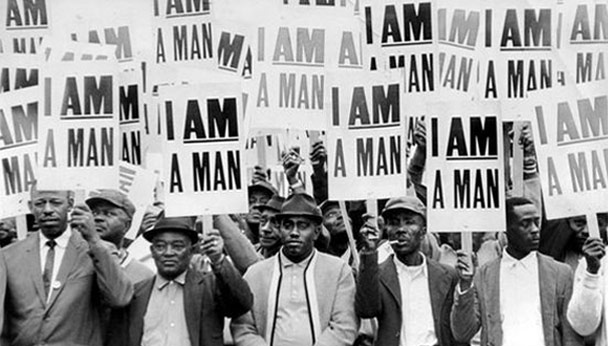
An iconic photo from the 1968 Memphis Sanitation Workers Strike. Martin Luther King, Jr. traveled to Memphis to support the sanitation workers, and it was there he was assassinated.
Otis Elliott and Göran's grandma Eloise

On Goran's side, his father and father's sister Dorothy were raised by Otis Elliott. Aunt Dottie described Otis as a kind and good father who raised them as his own kids, and provided a stable, loving influence in their lives. Like my grandma's uncle Henry, Otis was a humble, hard working man. Otis was a sanitation worker in Memphis, Tennessee during the sanitation workers strike of 1968, a pivotal moment in the Civil Rights Movement. He was always (justifiably) proud of his role in that historic movement for equality and justice that has shaped all of our worlds.

Certainly our genetic heritage is a huge part of making us who we are. But family is much more than just genes ("genealogy"). Individually and as families, we are who we are as well because of the things we inherited spiritually and emotionally and socially from foster parents, mentors or teachers.

Saturday, July 29, 2017

Why I Stay

This is the text of the talk I gave at the 2017 Sunstone Symposium session "Why We Stay" at the Ray A. Olpin Student Center, at the University of Utah in Salt Lake City, on Friday, July 28, 2017. Other presenters were Robin Linkhart, Maxine Hanks, and Nathan McCluskey.

I was excommunicated from the Church in 1986. I am a gay man in a 25-year-long relationship with my husband Göran Gustav-Wrathall. We were legally married in July 2008. Over the years people have asked me how it is that I could consider myself Mormon if I'm not a member of the Church. What covenants are there for me to renew on Sunday morning, sitting in the pews, as I pass, without partaking, the sacrament tray to the person sitting next to me? To the extent that there is a relationship between me and God that has the Church as a context, real as it is to me, it is invisible to outside observers. That’s OK. I stay because I cannot deny what I know.

God is real. Christ is real. The Spirit is real. When the Spirit is present, I know it is present. When it is gone, I feel its absence. When I obey its promptings, I have it with me. And when I disobey, I lose it. I can and do lose it on occasion. And with the Spirit, my life is infinitely fuller and richer and more peaceful and meaningful, than without it, so I obey, to the best of my ability. And when I lose it, I do whatever I need to do to get it back again. And one of those things is to stay active in my ward and to keep the discipline of the Church and the Gospel in my life.

I stay because God has told me that the Church of Jesus Christ of Latter-day Saints is his church and it's where he wants me. It’s where, time and time again, as recently as the last time I attended my south Minneapolis ward two weeks ago, the Spirit meets me and teaches me. My heart is softened, the Lord shows me my weaknesses and works with me and draws me to him. At times I have been reassured. At times I have been corrected. I find myself renewed as I meditate on the Sacrament prayer, as I make those promises in my heart, and ask for the Lord’s help to keep those promises. I have had sacred experiences with my priesthood leaders, including through blessings they have given me, that convinced me of the reality of priesthood power. I have witnessed and been the beneficiary of the miraculous healing power of the priesthood. I revere the priesthood as I revere God. I have been blessed to have my fellow Saints claim me as one of their own, and care for me, and encourage me. They accept me and my husband with love and without judgment, and they trust me to find my way forward through faith and hope and love the same way as everybody else.

Are there complications and contradictions? The main one is that I feel prompted to stay true and committed to my husband. We experience all the challenges of any couple, as I've observed both among those who've managed to make their marriages work as well as those who haven't. My marriage to Göran is a school in which I learn patience and sacrifice and empathy. I learn what it is to be one with another human being. My relationship with Göran does not cause me to lose the Spirit. To the contrary I've experienced a richness of the Spirit as I've honored my commitments to him.

What does this mean? I trust that the seeming contradictions between my experience with my husband versus church teaching and policy will all work out. It will work out for me personally as long as I keep that Spirit guide in my life. In my last meeting with my stake president, he simply counseled patience. “What is time unto the Lord?” he said. I am learning patience above all. Time and life experience will grind away everything ephemeral and show what is eternal and what is not.

The older and more experienced I become, the more I am aware of my weaknesses and failings and my need for grace. I have learned how utterly dependent my happiness is on the first principles of the Gospel, faith and repentance. Faith is not merely belief, it is allowing oneself to trust divine providence, even when one cannot see the ends toward which that providence guides us. Repentance is not merely an act, it is a posture, a way of life, an openness to learn and grow and become. When we fall, it is a willingness to pick ourselves up and start over. I am grateful for the grace God has shown me time and time again, often when I knew myself unworthy of it. This is a journey that must be renewed daily. It does not matter how far I've travelled in my journey up to this point. I will never reach my destination if I ever stop walking.

Sometimes I can barely believe I've been on this path for 12 years already. There have been a couple of moments in my journey with the Church when I have wondered how I would continue on with it. Not necessarily doubted that I would continue, but wondered as in having a sense of amazement. One of them was in the immediate aftermath of the November 2015 LDS policy on gay families.

On the afternoon of November 5, 2015 I was chatting on Facebook with other leaders of Affirmation when news of the policy began to break in social media. It wasn't until I saw copies of authenticated text from the new handbook that it really began to sink in. My initial personal reaction was not positive. I think among the first words out of my mouth were, “That's barbaric.” It seemed vindictive to me. In that moment, it looked to me like revenge for the Church’s stunning defeat in the Supreme Court, in Obergefell v. Hodges. And to me it was barbaric to use children to strike at the parents. I knew, and still know the personal situations of enough LGBT Mormons in same-sex relationships raising children in the Church to immediately grasp what impact this would have on them, not to mention the larger impact that this could have on LDS attitudes toward the LGBT community.

As I continued to reflect, there were two dominant thoughts in my mind. The first was that any hope of broadening connections between the larger LGBT community and the Church had been dashed. During my time of service as senior vice president and as a member of the board of Affirmation I and other leaders in the organization had been working hard to broaden those contacts. We had opened up a dialogue with church leaders at all levels, and had been meeting with LDS Church public affairs since December 2012. We were striving to make room for LGBT Mormons to claim their faith as Latter-day Saints, as I have since my profound conversion experience in September 2005.

In September and October 2016, Affirmation conducted a survey of its membership worldwide. Based on the survey data, which looked representative of the Affirmation community that we served, over half of Affirmation members reported being active in the Church prior to the policy. After the policy that percentage dropped to somewhere between 20% and 25%. In a January 2016 leadership gathering in Los Angeles, Affirmation leaders expressed anger, a sense of betrayal, and even guilt for having encouraged LGBT Mormons to engage with the Church. We had observed widespread trauma among LGBT Mormons and their families.

My other dominant thought was less a coherent thought and more a sense of gnawing hurt, sadness and doubt. If I had to put words to it I would say I was wrestling with my sense of my own place in all of this. Hadn't the Lord told me to come back to the Church? Hadn't the Lord reassured me that my relationship with my husband was blessed by him, that I should honor it and safeguard it as one of my greatest personal treasures? I was running for president of Affirmation, and had made the decision to run based on personal prayer and fasting and a clear sense that this was also something the Lord wanted me to do. How was I supposed to do this now? I remember the morning of November 6, I got up out of bed, went downstairs to kneel in our living room and pray before beginning my daily scripture study. I remember feeling heartsick, wishing that what had happened the previous afternoon had been just a bad dream.

But then I began to pray. I began to pour my heart out to the Lord, saying simply, please help me to understand. Please help me to know what to do. And it was like a light went on. Peace flooded through me. My mind was filled with light and reassurance. And the Lord in essence said to me don't worry about this. I've got this one. And you and your husband are still OK.

It was hard for me to articulate what this personal revelation meant, because my sense of things was so counterintuitive. Most members of the LGBT Mormon community saw the policy as a giant step backwards, as a triumph of bigotry. I saw it now as a step forward. A step through. We had to go through this to get to the other side. And the other side would be very, very good.

What had we lost? We had lost some illusions about a liberal progressive evolution of church policy on this issue. I was always skeptical of that kind of a scenario. I always suspected that this issue could only be tackled head-on, in the form of listening deeply to the real stories of LGBT Mormons, followed by doctrinal searching and prayer for new revelation.

What we hadn't lost was ourselves, our stories, in their depth and totality. The Church might not understand us, but God does. God sees us. God saw me and said I was OK and that I need not worry and that he had this one.

In the weeks after, I saw signs that ordinary, mainstream, believing heterosexual Mormons were really struggling with this. My Bishop called me to see if I was OK. We met and talked. He told me that by his estimate at least 60% of the members of our ward were struggling with this. The Sunday after the policy a stranger came up to me in church and asked if I was John Gustav-Wrathall. When I told him I was, he told me that he was investigating the Church. He said to me, “I just wanted you to know that I'm with you on this one.” Other members of my ward came up to me and hugged me and promised me that I was not alone.

At the end of November my mother passed away, and I spoke at her funeral. I told the story of her own personal revelation telling her that her gay son was OK, and prompting her to accept my husband as her own son. After the funeral, it seemed like there were a procession of members of my dad's ultra conservative Springville, Utah ward coming to me and wanting to talk about the policy, many of them with tears in their eyes.

In early December, I asked for and was quickly granted a series of meetings with church representatives and leaders in Salt Lake. I met with an apostle, and, after telling some stories of the trauma that I had observed among ordinary LGBT Mormons, I said, “On the drive up here, I was discussing the policy with my father. My father was very troubled by the term apostate. I am now defined as apostate under this policy. I told my father that I did not believe it was the Church’s intention to stigmatize me or others in my situation. The concept of apostasy is simply used to draw a line between what the Church currently understands as doctrine and what it does not. Was I correct in what I told my father?” The apostle’s response was that what I had told my father was exactly right. It was clear to me that in his willingness to meet with me there was a desire to engage, to draw in and include despite very difficult doctrinal understandings. After writing about this meeting in a blog post in Times & Seasons, I was accused by some of lying about having met with church leaders. The disbelief was proof of what I already knew about the situation, namely that it is more complex, and our leaders recognize it as more complex, than labels like “apostate” are widely understood to imply.

Yes, there has been defensiveness. There has been retrenchment and doubling down and an intensification of anti-LGBT attitudes in some quarters of the Church. But there has been an opening up as well, an opening up and a deepening of dialogue. For good or for ill this is an issue that the Church can only move through, not back or away from.

The policy did create genuine trauma for LGBT Mormons. And it has been a duty of mine as president of Affirmation to make space for people to distance themselves from the Church. But I believe that some of us are called to stay, and the Lord has a very important role for us as part of his plan to move us not away from or around but through.

My testimony has never required members of my ward to “be nice” to me. Nor has it required that the Church treat me as equal. It has nothing to do with the membership of the Church somehow collectively holding correct beliefs about everything. It doesn't piss me off when somebody says something stupid in Sunday school or priesthood meeting. My testimony doesn't require an aesthetically pleasing account of church history. As an historian, I like my history messy, by the way. I like it human and real. The hand of God is more recognizable in that kind of story. I don't know what to make of the Book of Mormon, other than to say that it is the most spiritually powerful and transformative text I've ever encountered. For me, the jury is out as far as Book of Mormon historicity goes. I haven't been satisfied by the critics that it's a fraud, but there are certainly aspects of the text that are puzzling if we want to try to take it literally (which the text itself somewhat demands of us). I suppose that's fundamentally no different from any foundational scriptural text that exists anywhere. But I certainly know that the Book of Mormon is true in the way that is most meaningful to me, which is in the reading and the application of it.

For me the Church is not true “in spite of” the flaws of its members, “in spite of” our individual and collective missteps. It is true in them. It is true in our bearing with one another through them. The scriptures are more or less an archive of human error and divine correction. The trueness of the Church is in having an authentic relationship with a living God who is drawing us into a more god-like life. That’s what priesthood, at its core, is about. That kind of relationship, which demands the discipline of priesthood, necessarily involves us making both individual and collective mistakes, and requiring correction. I’m not sure God’s plan works any other way.

So I’m here, I’m queer, I’m Mormon. Get used to it.

In the name of Jesus Christ.

Amen. 

Monday, April 24, 2017

The Gift of Faith

Delivered at The Hearth Fireside Series on February 26, 2017, Atherton, CA


Matthew 15 
21 ¶Then Jesus went thence, and departed into the coasts of Tyre and Sidon.
22 And, behold, a woman of Canaan came out of the same coasts, and cried unto him, saying, Have mercy on me, O Lord, thou Son of David; my daughter is grievously vexed with a devil.
 23 But he answered her not a word. And his disciples came and besought him, saying, Send her away; for she crieth after us.
 24 But he answered and said, I am not sent but unto the lost sheep of the house of Israel.
 25 Then came she and worshipped him, saying, Lord, help me.
 26 But he answered and said, It is not meet to take the children’s bread, and to cast it to dogs.
 27 And she said, Truth, Lord: yet the dogs eat of the crumbs which fall from their masters’ table.
 28 Then Jesus answered and said unto her, O woman, great is thy faith: be it unto thee even as thou wilt. And her daughter was made whole from that very hour.

The story of the Syrophoenician or “Canaanite” woman (told in Mark chapter 7 and re-told in Matthew chapter 15) is unique in the Gospels, in that it is only story where Jesus refuses to bless someone. At least initially.

It’s easy to focus on the end of the story, in which Jesus miraculously heals the woman’s daughter long-distance. We’re inclined to interpret his initial refusal to bless as a test of the woman’s faith.

Except that Jesus’ refusal is coupled with what, on the face of it, looks like blatant racial or ethnic discrimination and insults.

“It is not meet,” says Jesus, in response to the woman’s pleas for a blessing, “to take the children’s bread, and to cast it to the dogs.” I’ve seen some exegetes try to soften the blow of the insult of comparing this woman to a dog by suggesting that the original Greek in the text was diminutive, that it didn’t have the same harsh connotations that referring to someone as a dog in Middle Eastern culture typically has. Maybe. Consider it through the eyes of the Canaanite woman. Her daughter was suffering, and she was being refused in language that literally dehumanized both her and her daughter.

In the Matthew version of the story, she followed them, crying after them from a distance, and Jesus refused to answer her. When the disciples begged Jesus to relent, just to make her stop, he replied tersely, “I am not sent but unto the lost sheep of the house of Israel.”

That phrase (not present in the Mark version of the story) was the key to James E. Talmage’s interpretation of the story. Jesus was not called by the Father to minister to the Gentiles. The keys to that work were not to be delegated until after Christ’s ascension.

The story might credibly have ended with that rejection. Most women in her shoes might give up and leave after being insulted. This would not, however, have been much of a story if it had ended there. It occurs to me that in the course of his ministry, Jesus might have said no to Gentiles seeking blessings many times, so often that it wouldn’t have seemed worth mentioning. This story might only have been told because of its exceptional quality; because it was the case of a Gentile who refused to take “no” for an answer, and whose faith was such that the blessing ultimately could not be withheld.

It is reminiscent of another story (recounted in Luke chapter 7) in which a Roman centurion beseeched the Jewish elders to intercede for him on behalf of a dying servant. Perhaps the centurion knew that Jesus was “not sent but unto… the house of Israel,” which would explain why he never appeared in person to Christ, and why he sent Jewish messengers to convey the message: “I am not worthy that thou shouldest enter under my roof… neither thought I myself worthy to come unto thee: but say in a word, and my servant shall be healed” (vs. 6-7). Jesus marveled at the man’s faith, and proclaimed: “I have not found so great faith, no, not in Israel” (v. 9). The Luke account does not specify whether the servant was of the house of Israel or not, but it does state that like the daughter of the Canaanite woman, the servant was healed thanks to the exceptional faith of a Gentile.

To return to the story of the Canaanite woman, her faith was such that she did not allow herself to be put off, neither by the insistent rejections, nor by the dehumanizing language. “Yes, Lord,” was her response to the ‘dogs’ comment, “yet the dogs under the table eat of the children’s crumbs.” It was when she said that, that Christ knew there was no blessing he could withhold from her. “O woman,” replied Jesus, “great is thy faith: be it unto thee even as thou wilt” (Matthew 15: 28).

As a gay man who am excommunicated, and who am unable to be reinstated into membership in the Church because of my 25-years relationship with my husband, and who have a testimony of the Gospel, and who am active in my LDS ward, I have occasionally been accused of accepting crumbs. I’ve been told that a self-respecting person does not do that. A self-respecting person demands a full place at the table and accepts nothing less.

I don’t believe for a single moment that that Canaanite woman believed either she or her daughter were of less value in the eyes of God than any child of the house of Israel. The proof of that was in her unwillingness to relinquish a blessing she knew her daughter needed; her perseverance until she had secured that blessing; her willingness to humble herself before God in order to claim that blessing. In a sense, by turning Christ’s refusal away with the words, “Yes, Lord, yet the dogs eat the crumbs,” she affirmed her infinite worth in terms that Christ could not deny. “Great is thy faith,” he said of her. Or “I have not found so great faith in Israel,” as he said of the Roman centurion.

To my way of thinking, it would have been her turning away, her giving up, that might have devalued her. To turn away might have been an admission that she or her daughter were less worthy of the blessing than anybody else Christ might have healed more readily. I am of infinite worth, and so is my husband, and so I show up at Church and I live the Gospel as fully as I am permitted within the current confines. My presence at church is simultaneously two things: a testimony of the truthfulness of the Gospel, and a testimony of my infinite worth.

This still begs the question: Why does the Church treat people in a discriminatory manner? Or, to put it in slightly harder terms, How could a church that discriminates against people, that is seemingly a respecter of persons, be true? As I was writing this talk, I was exchanging messages with a faithful lesbian mom who has been distraught because her daughter just turned eight years old, and will not be able to be baptized as her older siblings were. We can take the experience of LGBT people today, and put it in the context of long millennia of discrimination of some sort in the Church, for race, or gender, or ability.

God is no respecter of persons. If the story of the Canaanite woman is an illustration of anything, it is of this fundamental truth. But apparently God’s church is a respecter of persons. The story of the Canaanite woman is also an illustration of that reality.

Even Christ himself seemed somewhat bound or limited by that reality. The gospels' and the Book of Mormon's witness of Christ almost always shows Christ standing with the disadvantaged. It shows us that when society and/or the Church marginalize people, God stands with the marginalized. That is the normal ethic that God demands of us. But if we believe — and I believe it — that Christ was God incarnate, then the incarnate aspect of his being placed him in a temporal, worldly context and in the framework of all the limitations that came with that context. He could transcend it at times, but he couldn’t just dispense with it. And if Christ could not, then I’m not sure how I would expect his apostles to, especially when the scriptures are replete with examples of Christ’s apostles’ limitations. It doesn’t make the Gospel or even the Church less true.

We can theorize or speculate about why the limitations exist. Perhaps it is God accommodating human weakness. Perhaps when human beings learn to stop putting artificial limitations on someone because of their race or their gender or their sexuality or their gender identity or their ability, then God eagerly takes us to the next step of evolution as a human family. There is a fundamental Gospel principle that we are able to see God only to the extent that we become like him. The becoming like him part is a real challenge.

Perhaps God has some master scheme in mind that requires steps. Perhaps God could, for instance, only have overcome the innate human tendency toward idolatry by creating a “chosen people,” a necessarily limiting or discriminatory act. There’s scriptural support for the notion thatGod used the Law to discipline his chosen peoples because of our innate tendency toward selfishness and egotism, though the arc of the history of God’s engagement with humanity shows him weaning us toward a higher law of selflessness and compassion, free of the legalism and the harsh discipline of the past.

Nothing about the existence of these limitations or of the trauma they create for so many convinces me that God is absent or nonexistent. Amidst the pain, God is at work. I have had too many experiences that are unexplainable to me in any other way than that his hand has been in my life and that the restored priesthood is real, to not believe that God lives and that he is guiding the Church.

I am also convinced that God takes the principle of agency very seriously. It is the foundational principle of creation, and equal parts of human misery and transcendent joy in this life are the product of it.

All that having been said, whatever the reasons for legalism and discrimination in our institutional religious framework, it doesn’t change the fact that to be gay, lesbian, bi or transgender in this world today demands an extraordinary kind of faith. And that is why I want to directly and personally address the last half of my remarks to my fellow lesbian, gay, bi and transgender siblings here in the audience today.

There is a significant difference between us and the Canaanite woman in Matthew 15. The Canaanite woman had her daughter, and her daughter had her. They had the love of family; that is what drove this woman to demand a blessing from Jesus in spite of the rejection: her family. And many of us have lost our families. LGBT people are sometimes blessed to have our families come on this journey with us, but we’ve never been able to take it for granted. And in my time as a leader in Affirmation I have seen the absolute devastation and trauma of this total rejection so many of us experience from our families and from our church.

But here’s what I can say about the rejection we’ve experienced. Every significant thing I was told in the Church about what it would mean to be gay has turned out to be completely false.

I was told that gay people were incapable of real love, that we were incapable of forming lasting commitments. This year my husband and I are celebrating our 25th anniversary, and one thing I can say about the love between us is that it has never been deeper, or stronger, or more nourishing than it is now. That love has steadily grown, day by day, month by month, year by year, through trials and challenges and heartache and through mistakes and failings and forgiveness and through the raising and care of foster children. And if our love is not real, then I can’t imagine what real love is, because what we have surpasses my ability to express, in its power to heal and teach and inspire, and in its infinite potential.

I was told that if I entered into a same-sex relationship of any sort, that I would lose the Spirit of God. But I have the Spirit in my life, and so does my husband. How do you know when the Spirit is in someone’s life? When you see the fruit of the Spirit: love, hope, patience, faith, kindness, forgiveness, perseverance… Do I know gay people in same-sex relationships who manifest the fruit of the Spirit and who have gifts of the Spirit? I do in abundance. No matter our sexual orientation or gender identity, no matter our status in the Church or our life circumstances, if we seek God in patience and humility, he pours his Spirit out on us.

I have one thing to say about the Church’s current policy relating to gay people. If these things that I had been told were true — if real commitment and love were impossible in a same-sex relationship, and if a same-sex relationship denied us the possibility of having the Spirit in our lives or a relationship with God — then the policy would be wise and kind, evidently designed to prevent us from harming ourselves, to protect us from falling into lonely lives devoid of spirituality or meaning. I think our leaders believe they are protecting us.

I am the president of Affirmation, so I feel like I would be remiss in my duty tonight if I did not leave you with some affirmations.

First: We are greater than the rejection.

When people are unkind to us, when they reject us, there is a fundamental spiritual principle that we all need to be aware of. What you do to others, you only do to yourself. We are all interconnected. And we are all connected to God. That is why Christ said, “If you do it unto one of the least of these, you have done it unto me.” (Matthew 25: 40)

When people reject us, we might think it is some kind of reflection on our worth. But it is not. A person who rejects you may be revealing something unfortunate and unpleasant about themselves, but in their rejection there is not the least of an iota of reflection on who you are or what you are worth.

We are greater than the rejection.

Second: God does not reject us.

Read the founding scripture of Mormonism: “If ANY of you lack wisdom, let him ask of God, who giveth to ALL LIBERALLY and UPBRAIDETH NOT.” (James 1:5) It says “if ANY of you lack wisdom.” That means the only prerequisite is that we lack wisdom, which most all of us do. Or I can speak for myself and say I do. It says, God “giveth to ALL.” There are no disclaimers here, no exceptions, no requirement that you be straight or righteous or anything at all. It says ALL. It says “and UPBRAIDETH NOT,” which means that God does not scold us or punish us for asking him the “wrong” question. That’s not how God operates. He doesn’t care what question you have to ask. He doesn’t “upbraid” you for that. He cares only that you ask him, that you turn to him. And it says “LIBERALLY,” which means, when we ask God for something good, he is not stingy. God does not hold back. He pours out blessings on us.

How do I know this scripture is true? Because I have tested it, and I have found it truer than I ever had been able to imagine.

God does not reject us.

Third: LGBT people are in a better position to understand the Gospel than many of our straight brothers and sisters.

Why? Because we have to work and struggle and fight for every ounce of understanding about ourselves. Because we are not permitted to take anything for granted. Because we have to build a relationship with God that is refined through trial and error. Because we learn the heart of the Gospel by forgiving. And right now we have plenty of opportunities to forgive.

Forgiving does not diminish us. Forgiveness is one of the greatest, most humanizing gifts of the Atonement. It is the most powerful way we can realize for ourselves that first affirmation I shared with you, that we are greater than the rejection. It enables us to access the forgiveness we need for our mistakes and shortcomings. It unlocks the power of love and redemption.

The gospel applies to us every bit as much as it applies to every other child of God on the planet. But when we are marginal, when we have experienced rejection and loneliness, when we have had to sit in the dark without human friends or guides, then we are in a position to acquire deep understanding.

We LGBT Mormons are in a better position to understand the Gospel in all its depth and power than we think.

We have gifts to offer the Church, without which the Church cannot prosper.

I have a vision of Mount Zion, of the Lord’s Holy Temple, where we will all some day gather, gay, lesbian, straight, bi, transgender, non-binary, people of every race and tribe and background, women and men. I had a dream once, that we were all together in the temple, dancing, like the Saints who danced in the Nauvoo Temple before they were driven out. In this vision of Mount Zion, there will be no poor among us, no marginal people, no people on the edges. I will see you there, with my husband, and with our foster sons, with my parents and siblings and nephews and nieces, and uncles and aunts and cousins and ancestors and descendants. And the Spirit will be poured out on all of us with a richness and a power that none of us imagined possible; with a richness and power that our straight brothers and sisters had never realized was possible because until that moment, we LGBT folks had been missing from the equation.

I have a friend here in Oakland, Judy Finch. Judy has been one of the most constant supports to me through one of the most challenging times of my life. One of the things that Judy keeps reminding me is that the most important thing I can do for anybody else is to take care of myself, to do whatever I need to do to be healthy and happy and whole. I can’t help anybody else if I don’t do that.

And so in closing I want to pass Judy’s reminder on to all of you. I love you deeply. Every morning I wake up to thoughts of you. I pray and I work throughout the day, thinking what can I do that will bring hope and encouragement to my siblings who are lesbian and bi and transgender and gay. And I have seen the trauma so many of us have experienced and I have felt the pain of it and I have been amazed by your capacity to transcend it.

But I say: Take care of yourselves. Do whatever you need to do to be happy and healthy and whole. You don’t need to go anyplace where you are not affirmed in the fullness and integrity of who you are, all of you, every molecule of you.

And if you have begun to catch a vision of yourselves as whole and good and complete and as a divine child of God, if you have found that healing ground and that spiritual center, there is work for you to do. There is much healing needed in the world. And I invite you to join in that work.

In the name of Jesus Chist, our Teacher, our Savior and our Redeemer. Amen.